Budgeting for Adult AI Chat Over a Year
Budgeting this habit in money is impossible from published material, because the platform does not publish prices in the sources available here. Budgeting in time and messages is straightforward. Four sessions a week at half an hour each is 8.0 hours a month, which is 96 hours a year — and that single number is more useful than any recurring charge, because time is the resource you cannot top up.

Key takeaways
- Annualise everything: 4.0, 8.0 and 16.0 hours a month become 48, 96 and 192 hours across a year.
- Messages scale the same way: 40 a day is 1,200 a month, which is 14,600 a year at the same rate.
- Crushon's own framing of the service as Porn Chat AI lists characters, privacy and adaptive responses — no figure about price appears anywhere in this article because none was published in the source material.
- Compare the annual total with other recurring habits before deciding a level is expensive or cheap, since the time cost is the part that actually repeats.
Convert a habit into an annual figure
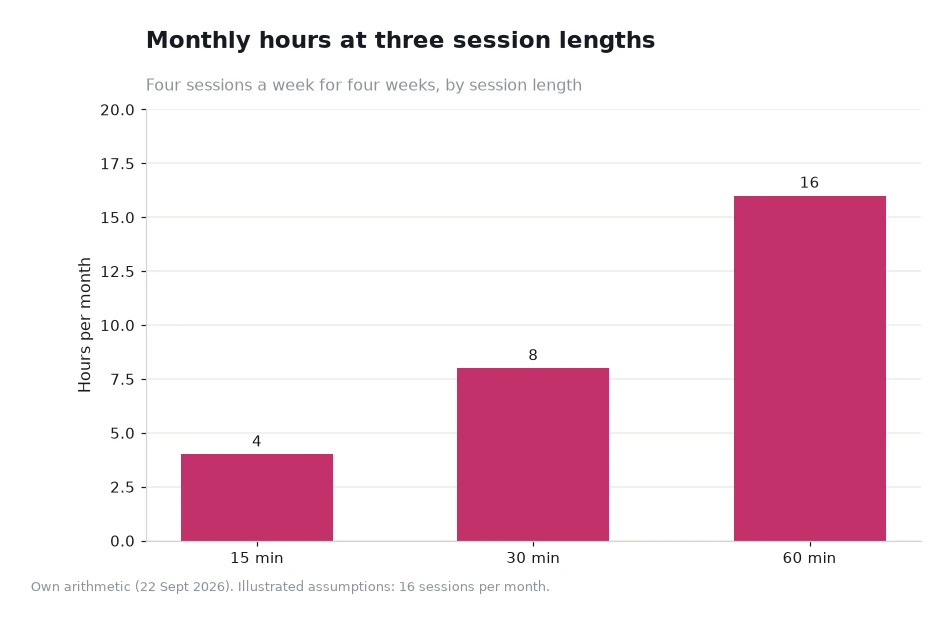
Monthly totals are too small to judge and daily totals are too noisy, so annualise. Take four sessions a week, which is 16 sessions a month. At 15 minutes each, that is 240 minutes a month, or 4.0 hours, which becomes 48 hours over twelve months. At 30 minutes each it is 8.0 hours a month and 96 hours a year. At a full hour each it is 16.0 hours a month and 192 hours a year.
Those three figures — 48, 96 and 192 — describe the same weekly rhythm and differ only in how long each session runs. That is the whole point of annualising: a habit that looks identical in a weekly plan has a fourfold range once it is projected across a year.
Messages annualise just as cleanly. Ten a day is 300 a month and 3,650 a year. Forty a day is 1,200 a month and 14,600 a year. A hundred and twenty a day is 3,600 a month and 43,800 a year, which is the sort of number that makes a habit look different to the person doing it.
What the annual figure is for
An annual total is a comparison tool, not a verdict. Put it beside other recurring parts of your week: a nightly hour of streaming is 365 hours a year, a thirty-minute daily commute is about 120 hours a year working, and a weekly two-hour club evening is 104 hours. Against those, 96 hours of chat is unremarkable.
It is also a planning tool. If the year ahead contains months that are busier than others, the annual figure tells you what an average month must look like to sustain the habit, and it makes dropping to a lighter pattern a decision rather than a collapse.
The one thing the annual figure cannot do is price the habit, and it is worth being blunt about why: no price appears in the material this article is based on. Commercial terms belong on the platform's own plan page, and a reader budgeting in money should read them there rather than accepting a number from an article like this one.
| Habit | Per week | Per month | Per year |
|---|---|---|---|
| Light: 10 messages a day | 70 messages | 300 messages | 3,650 messages |
| Moderate: 40 messages a day | 280 messages | 1,200 messages | 14,600 messages |
| Heavy: 120 messages a day | 840 messages | 3,600 messages | 43,800 messages |
| Sessions, 15 min each | 4 sessions | 4.0 hours | 48 hours |
| Sessions, 30 min each | 4 sessions | 8.0 hours | 96 hours |
| Sessions, 60 min each | 4 sessions | 16.0 hours | 192 hours |
Worked example: three years, three habits
Extend the arithmetic to three years, because habits are long. The light reader at 48 hours a year reaches 144 hours in three years. The moderate reader at 96 hours a year reaches 288. The heavy reader at 192 hours a year reaches 576, which is the equivalent of fourteen working weeks at 40 hours.
Prune it differently and the same data reads as leverage. Moving from 60-minute sessions to 30-minute sessions halves the annual figure from 192 to 96 hours and changes nothing else about the service. Moving from 30 to 15 halves it again, to 48. There is no feature list that produces a saving of that size, which is why session length is the first lever a time budget should address.
Add the message side and the picture completes. A reader at 14,600 messages a year who keeps one character in twenty has 730 saved entries by year end, a number high enough that pruning stops being optional. Even at one in a hundred kept, the library reaches 146 entries, and the maintenance rules worth having are the ones that keep a list that size usable rather than decorative. All the figures in this section are worked examples of a habit, not measurements of the platform.
Budgeting the other resources
Time is not the only column. Attention is finite in the evening even when the clock is not, and a 192-hour year assumes that every one of those hours is available at a good moment. Most readers find their realistic annual figure sits closer to the 48 or 96-hour row simply because of when the sessions can happen.
Storage of your own records is the second column. A note per saved character is trivial in size, but a written log of scenes is not, and readers who keep one should decide early whether it lives in a document or dies with the session. Deciding that in January saves an awkward cleanup in December.
The third column is the commitment itself. A year is long enough that a level chosen in a good month may not fit a bad one, which is why the plan page is worth reading against your own annual figures rather than against a passing preference, and why the trending board is a poor guide — its 20 entries refresh every Thursday, and 24.3M views against 7.1K favourites on the busiest card says nothing about how much time you personally will spend.
Do the arithmetic once a year
Once a year, write down three figures: messages sent, hours used and characters kept. Compare them with the table above and with last year's version, then make one decision — keep, reduce or change level — and leave the question alone for twelve months.
That rhythm fits the way habits actually change, which is slowly and in steps. If you want to know what the service offers at each level, the description and FAQ on the porn ai chat page set out the advertised properties in the operator's own words, and the commercial detail lives on the plan page. Everything else in a yearly budget is your own arithmetic.
Frequently asked questions
Why is there no price in this article?
Because none was published in the material used here, and publishing a number that nobody confirmed would be worse than publishing none. Commercial terms belong on the platform's own plan page.
What is the single biggest lever on an annual figure?
Session length. Halving it halves the annual hours without changing anything else, while message volume changes far less than most readers expect.
How often should the budget be reviewed?
Annually is enough. Habits move slowly and a monthly review turns a decision into a recurring chore with no additional information.
Write the year down in three lines
Messages, hours, characters. Put the three numbers somewhere you will see them again in twelve months, and compare rather than estimate. The comparison is the value of the exercise, because the number you remember is usually the busiest week rather than the typical one.
Then spend the time you have budgeted on the part that makes it worth it: reading a description properly, writing an opening line well and pruning the list you keep. A habit that fits inside its own annual figure is a habit that survives more than one year.
Data and sources: service description and FAQ on the platform's adult chat page[1], with commercial and level detail on the plan page[2] and the Thursday weekly chart on the trends board. Pages and counters were read on 22 Sept 2026; no price, tier name or user total is quoted because none was published in the source material, and every time and message figure here is a worked example. Written for an adult readership, 18+; read 22 Sept 2026.