Checklist: Sourcing Hotel Furniture for a Renovation Project
Hotel furniture for a renovation must fit the design, operating requirements, site constraints, and installation schedule. A checklist keeps room quantities, specifications, samples, packaging, delivery, and approvals connected. Buyers should coordinate existing conditions and access early because a suitable product can still fail if it cannot enter the room or arrive before installation.
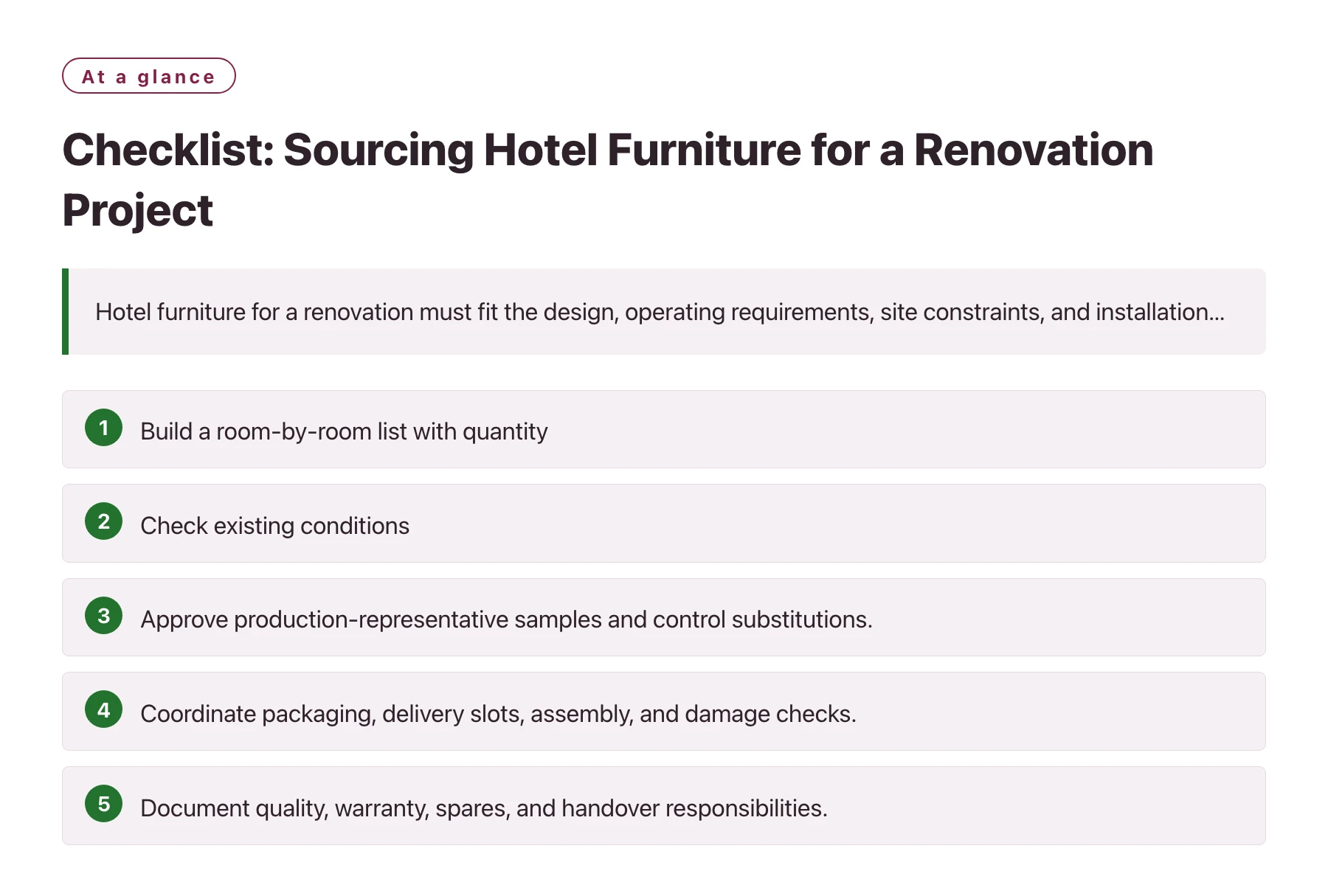
Key takeaways
- Build a room-by-room list with quantity, dimensions, finish, and installation date.
- Check existing conditions, access, electrical or wall interfaces, and removal work.
- Approve production-representative samples and control substitutions.
- Coordinate packaging, delivery slots, assembly, and damage checks.
- Document quality, warranty, spares, and handover responsibilities.
Audit and inspection plans are most useful when they support a named decision with evidence within a stated scope.
1. Survey rooms and existing conditions
Record room types, layouts, measured openings, floor and wall conditions, ceiling height, corridors, elevators, loading routes, and renovation sequence. Note furniture that remains, moves, or requires disposal. Verify dimensions on site rather than relying only on older plans.
Identify accessible routes, work hours, security, dust protection, and storage limits. Schedule deliveries around demolition, finish trades, and room outages.
Coordinate lead times for custom pieces and imported components with the renovation calendar. Confirm where each package can be staged without blocking active work, and ask how goods will be identified if several floors arrive together. Allow time to inspect samples before the room is taken out of service.
2. Build a room-by-room furniture schedule
List each item by room or zone, model, dimensions, material, finish, upholstery, hardware, quantity, spare quantity, and required-on-site date. Include bedside tables, desks, seating, wardrobes, beds, headboards, casegoods, and public-area furniture as relevant.
Record interfaces such as wall fixing, power, lighting, housekeeping storage, clearances, and accessibility. Distinguish furniture supplied by the vendor from accessories or installation materials supplied by others.
3. Specify guest use and operating needs
Describe who uses each item, expected load and frequency, cleaning routine, maintenance access, replaceable parts, and design life expectations if stated. Identify sharp edges, pinch points, stability, upholstery care, and stain or fire requirements for qualified project review.
Name materials, substrates, coatings, textiles, foam, dimensions, tolerances, color, and accepted variation. Avoid generic “hotel grade” claims unless linked to a project-defined requirement and evidence.
If the project has standards for flammability, stability, accessibility, or durability, have the relevant designer or compliance owner identify the exact market requirement and test evidence. Supplier brochures can support discovery but should not replace project-specific review.
4. Coordinate finishes, samples, and mockups
Request samples of wood, veneer, fabric, metal, hardware, and upholstery in production-representative form. Review colors in the room lighting and beside adjacent floors, walls, and textiles. Label each sample with supplier, material, finish, code, and revision.
For key room items, build a mockup that includes installation, clearances, operation, and cleaning access. Record approvals and open issues by item code. A finish approval does not automatically approve stability, construction, or market compliance.
5. Check supplier and production readiness
Confirm actual factory, product capability, subcontracts, sample process, materials, capacity, production milestones, inspection, and packaging. Ask which drawings and finishes are controlled at the workstations and how changes are approved.
Review quality-system evidence as one input. ISO 9001:2026 specifies quality management system requirements; a certificate does not replace product approval or order-specific checks. [2] [2]
6. Plan renovation delivery and installation
Build a schedule from room release backward through sample, production, inspection, packing, transit, receiving, assembly, installation, touch-up, and room handover. Coordinate floor or room sequence and identify storage or installation dependencies.
Confirm who unloads, distributes, assembles, anchors, protects, and removes packaging. ICC Incoterms® rules clarify certain delivery tasks, costs, and risks between seller and buyer; separately define site unloading, internal movement, installation, and acceptance. [1] [1]
7. Protect goods through packing and site receipt
Specify corner and surface protection, carton marks by room, hardware kits, assembly instructions, pallet dimensions, and stacking. Include a packing sample when finish damage or missing hardware would delay installation.
At delivery, count packages by room and item, inspect carton condition, photograph damage, and set aside incomplete or incorrect goods. Keep labels and packing records until room installation is closed.
8. Manage changes and decisions
Record supplier, item code, drawing, finish, sample, lead time, cost, inspection status, and delivery window in one tracker. Assign owners for design, procurement, operations, quality, compliance, and site receipt decisions.
Require written review for changes to factory, materials, dimensions, hardware, upholstery, finish, or assembly. Recheck mockup, clearances, cost, schedule, and documentation before approval.
Use a formal approval log for substitution requests and date each response. Check that the project schedule reflects revised manufacturing and installation dates, and notify operations when a change affects room availability or guest service.
9. Close the package at handover
Collect care instructions, warranties, spare parts, touch-up materials, approved finish codes, assembly records, and defect list. Confirm the operator knows how to request replacement parts and report later failures.
Buyers using Shanghai JS Sourcing can align product packages, delivery sequence, samples, inspection, and support scope before awarding the renovation order.
Sources
Frequently asked questions
What should a hotel furniture renovation checklist include?
Include room quantities, measured dimensions, materials, finishes, samples, access, delivery sequence, installation, inspection, warranty, and handover.
When should furniture samples be approved?
Before production and early enough to resolve finish, fit, comfort, maintenance, and interface issues in a representative setting.
Who should handle furniture installation?
Assign unloading, internal distribution, assembly, fixing, protection, and punch-list ownership in writing.
How can buyers reduce room-delivery errors?
Label packages by room and item, reconcile quantities, share the installation sequence, and inspect package condition at receipt.