The First Week in a Hosted Rack: A Handover Checklist for 2.33 PH/s
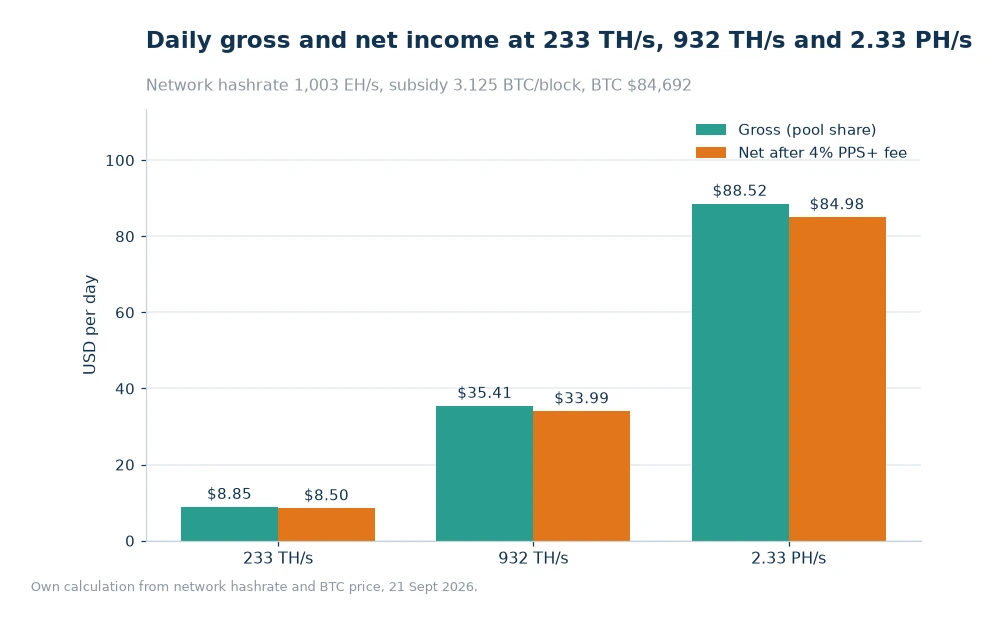
2.33 PH/s earns 0.00104525 BTC a day, which is $88.52 at $84,692 and $84.98 after the listed 4% on the block-reward component. Once those machines sit in somebody else's building, the only evidence they are working is the difference between two dashboards. The first seven days are when that evidence is easiest to collect and hardest to argue with later.
Key takeaways
- 2.33 PH/s produces 0.00104525 BTC a day, or $84.98 net after the listed 4%.
- Record serials, firmware and worker strings before the pallet leaves your site.
- Compare the host's hashrate reading with the pool's own view every day for a week.
- Reconcile the first invoice against the credits, not against the host's summary.
Before the pallet leaves
Photograph every unit from three angles, note the serial on the chassis and on each board, and write down the firmware build currently running. Then export the worker list from the pool account with the exact string each machine reports. These records cost an afternoon and settle most disputes later, because a board that arrives with a different serial or a unit running unfamiliar firmware is a fact rather than a suspicion.
Pack the machines the way you would want to receive them: original foam if you kept it, rigid corners, and a moisture absorber per carton. Label each carton with the serial range inside, and keep the list with the shipping documents. A host that receives twelve unlabelled boxes will install twelve unlabelled machines, and the mapping between your records and its rack positions disappears.
The shortlist itself should start from the ViaBTC Mining Companies listings, where operators that accept third-party equipment sit beside companies that only mine on their own account. The Miner Hosting label is the useful filter when the machines belong to you, and a site that cannot describe its acceptance procedure before you ship will improvise one after.
Day one: the first shares
Within an hour of power-up, the pool account should show hashrate for each worker. Do not accept a screenshot of the host's dashboard as proof; open the pool's own pool state view and read the worker list there. The number to check is the sum across workers against the nameplate figure you shipped, minus any unit the host says is still being commissioned.
A shortfall on day one is normal for one or two boards that need reseating. A shortfall that persists past the first shift is not. Ask which physical unit maps to which worker string, and ask for the error count per board. If the host cannot answer with a rack position, the machines are installed but not inventoried, and every later conversation starts from zero.
Day three: heat under real load
Day three is when the site has run through a full thermal cycle. Request intake and exhaust temperatures for the rack, the fan speeds the machines settled at, and any unit that has throttled. A machine that holds its rated hashrate at the site's ambient temperature is fine; one that steps down every afternoon is being cooled to a budget rather than to its specification.
This is also the moment to test the alerting path. Ask the host to power-cycle one unit at an agreed time and confirm that your own alert fires. If the notification arrives only in the host's dashboard, the monitoring is theirs, not yours, and you will learn about failures when the monthly total looks light rather than when they happen.
Day seven: credits against the invoice
By the end of the week the account should hold seven daily credits at roughly 0.00104525 BTC each, allowing for difficulty and the exact hours run. Add them up, value them at the price you use for bookkeeping, and hold the total beside the first invoice. The difference is the true cost of the slot, and it is the only figure worth carrying into next month's decision.
Two adjustments make the comparison fair. Strip out any one-off charges for installation, crating or a deposit, and note them separately. Then divide the recurring total by the seven days to get a daily cost, so it can sit next to the daily credit without a mental conversion. A weekly invoice compared with a daily credit is how small discrepancies turn into arguments.
When the two dashboards disagree
Disagreement is not automatically a fault. The host may sample hashrate every five minutes while the pool scores shares over a rolling window, so a 1% gap is ordinary noise. A persistent 5% gap over three days is a different matter: it points to rejected shares, a network path issue, or a unit the host believes is running and is not.
Escalate with the worker string, the pool's figure, the host's figure and the timestamp in one message. Keep the thread in writing and ask for the fix date. Most hosting problems are resolved by making the comparison specific; vague complaints about "lower than expected" invite a vague reply about "normal variance".
| When | What to check | Pass condition | Who holds the record |
|---|---|---|---|
| Before shipping | Serials, firmware, worker strings | Every unit photographed and listed | Miner |
| Day one | Pool-side hashrate per worker | Within commissioning tolerance of nameplate | Miner |
| Day three | Rack temperatures and throttle events | No sustained stepping down at site ambient | Host, shared |
| Day seven | Seven credits against the first invoice | Daily cost below the daily net credit | Miner |
Worked example
Take the first week at 2.33 PH/s and put a number on a shortfall.
- Network output: 144 × 3.125 = 450 BTC a day.
- Per TH/s: 450 ÷ 1,003,000,000 = 0.00000044865 BTC.
- 2,330 TH/s × 0.00000044865 = 0.00104525 BTC a day.
- At $84,692: 0.00104525 × 84,692 = $88.52.
- After the listed 4%: 88.52 × 0.96 = $84.98 a day.
- Seven days at that rate: 84.98 × 7 = $594.86.
- A 5% hashrate shortfall for the week removes 0.05 × 594.86 = $29.74.
- The same shortfall sustained for a quarter would cost about $386.60, which is why day three matters more than it looks.
Frequently asked questions
How soon should the pool show my hashrate after installation?
Within the first hour for machines the host has powered. A worker that has not appeared by the end of the first shift is not commissioned, whatever the host's own dashboard reports.
Is a small gap between host and pool normal?
Yes, up to a point. Different sampling windows commonly produce a gap of about 1%, while a 5% gap that lasts three days usually points to rejected shares or a network problem worth escalating.
What records should I keep for the first month?
Serials, firmware versions, worker strings, daily pool credits and the first invoice with one-off charges separated. Those five items answer almost every question a host or an accountant will ask later.
Keep the week-one file open
The first week produces a small set of documents that outlive the contract: the shipping list, the worker export, the temperature readings, the seven credits and the invoice. Keep them in one folder and add the monthly reconciliation to it. When a board fails in month eight, the serial history is there; when a renewal quote arrives, the daily cost trend is there.
Install the ViaBTC App on the phone that travels with you, so the worker list and alerts are one tap away rather than a laptop login. The Statistics page then gives the network context for any reading that looks odd. A hosted site is only as transparent as the records the owner keeps.
Sources: ViaBTC companies, pool state, app and statistics pages for listing categories, worker views and the listed 4%[1]. Read 21 Sept 2026: difficulty 132.76 T, network hashrate 1,003 EH/s, 3.125 BTC per block, 144 blocks a day, BTC $84,692. Published 24 Oct 2026.